
How to Search Civil Dockets
Start at Search ARCourts. A full case number is the fastest way in. Without one, type a party or organization name and filter by Fulton County, the right court, and the civil case type. Match the caption and party roles before you rely on the event history. That quick check keeps you out of someone else's case file.
Nothing showing up? Work the fallbacks. The Fulton County Circuit Clerk and Recorder sits at 123 South Main Street, Salem, reachable at (870) 895-3310, by fax at (870) 895-3383, by email at vickiefcclerk@gmail.com, or by mail at P.O. Box 219, Salem, AR 72576. Counter hours run 8:00 a.m. to 4:30 p.m. on weekdays, through lunch, except holidays. District civil and small-claims questions go to (870) 895-4136 or 455 North Main Street. A public terminal is not guaranteed.
- Identify circuit, district, domestic-relations, or probate jurisdiction.
- Search by full case number or participant and organization fields.
- Confirm Fulton County, court, caption, and party roles.
- Read service, motion, setting, order, and judgment events in date order.
- Ask the record-holding clerk for a plain or certified document.
Fulton County Civil Court Choice
Forum decides where a civil filing lands. Fulton County Circuit Court handles general civil and domestic-relations matters. District Court takes civil and small-claims cases, and it publishes its limit as $5,000. That cap is the county's stated figure. So weigh it against current law before any new filing. Probate routes through the County Clerk function. That is a separate legal role, even though one elected official serves as both County and Circuit Clerk.
| Matter | Fulton forum | Record contact |
|---|---|---|
| General civil or domestic relations | Circuit Court | Circuit Clerk |
| Civil or small claim within the published limit | District Court | District Court clerk |
| Probate | Probate Division | County Clerk function |
The wrong forum can produce a false "no result." City boundaries matter too. Fulton County portions of Ash Flat and Cherokee Village fall under a Sharp County judicial exchange, so the court where the case was filed controls, not the mailing address. A docket search aimed at the wrong court simply misses the case.
What a Civil Docket Shows
Think of a Fulton County civil docket as an index, not the whole file. The header carries the case number and caption. It also lists the court, case type, filed date, and status. Party blocks sort plaintiff from defendant, or petitioner from respondent. Then the event history logs each filing. It also records each action the court took.
| Caption | The formal case title and public party roles. |
|---|---|
| Opening event | The complaint or petition that began the case. |
| Service | Summons, return, and related notice entries. |
| Response | Answers, motions, and other filed responses. |
| Settings | Hearings, trials, conferences, and later resets. |
| Decision | Orders, judgment, appeal, and post-judgment events. |
A complaint or judgment listed there is still its own document. The case-history line points to it, but a portal printout never substitutes for the signed or certified copy the clerk holds.
Fulton County Civil Clerk Routing
Jane Ivey is the office's published contact for civil, domestic-relations, juvenile, and probate work. That routing matters. Those record types carry different access rules. A caller still reaches one general office. The clerk simply changes legal roles depending on the case type. When you contact the office, be specific. Give the exact court, case number, case style, document title, and filing date if known. Say whether you need a docket print, a plain copy, or a certified copy. Ask the price and payment instructions first. Fulton County publishes no local reproduction fee. It lists no certification fee, no online copy-order form, and no turnaround time.
Types of Civil Cases on the Docket
Circuit civil histories cover contract, tort, property, and other general claims. Domestic-relations cases use petition-based roles. They may hold restricted information. District Court keeps its own lower-value civil and small-claims docket. Probate runs through the County Clerk role. Let the exact case-type label on Search ARCourts guide the lookup. Juvenile and adoption records stay closed to the public. The clerk still maintains them. Guardianship, probate, and family files can mix public events with sealed fields or documents. Read search results with those limits in mind. Ask the clerk about the access process, not the substance of protected material.
Fulton County Civil Filing Charges
Fulton County posts its civil filing costs on the official filing-fee page. It lists the charges for opening or reopening circuit matters and notes the county's "efiling lite" status.
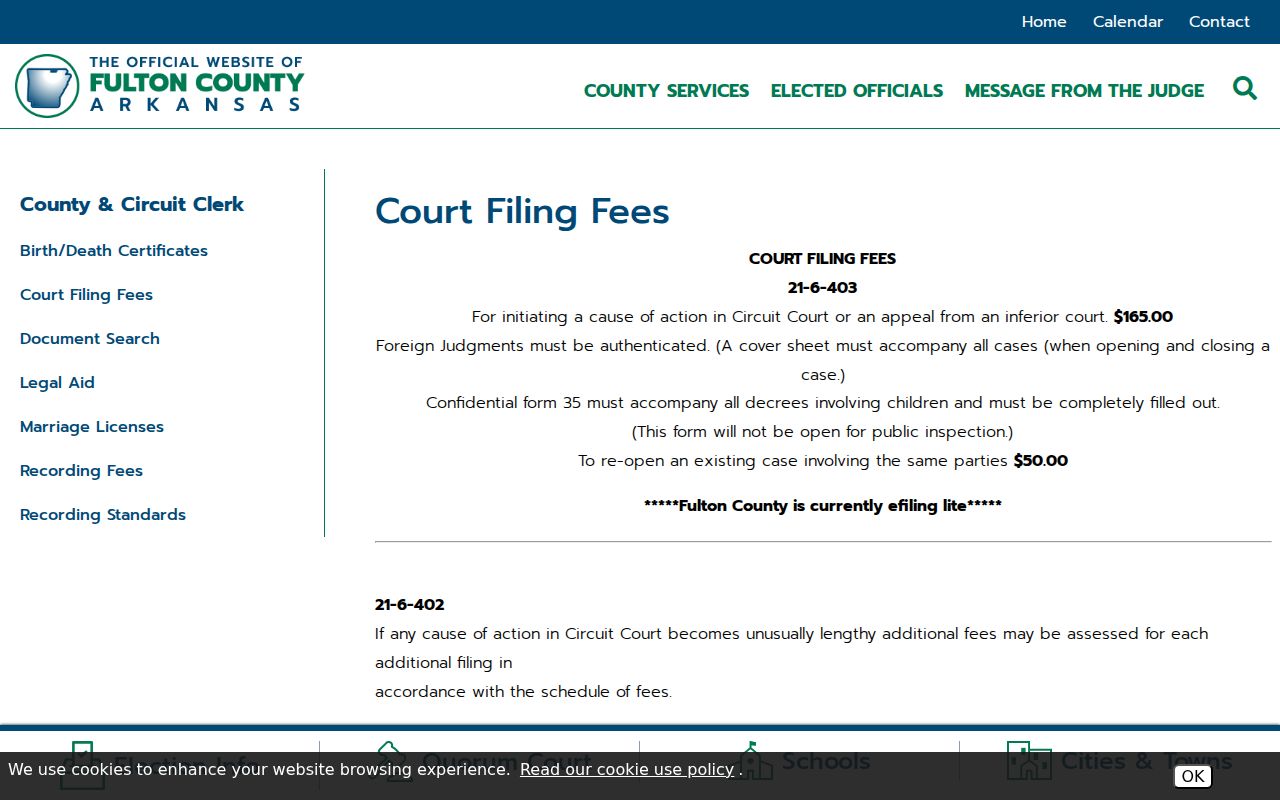
Those numbers are filing charges only. They are not copy prices from a Fulton County civil docket, and knowing the difference stops a requester from sending the wrong amount.
| Filing item | Published amount |
|---|---|
| Initiate circuit cause or inferior-court appeal | $165 |
| Reopen an existing same-party case | $50 |
| Issue writ of garnishment or execution | $20 |
| Signature and seal of summons or subpoena | $2.50 each |
| Plain or certified copy | Fee not published |
Settings and Hearings on Civil Dockets
A setting is simply a court event placed on the calendar. Search ARCourts may show a motion hearing. It may also list a case-management event, a trial, or another civil setting in the dated history. Fulton County posts a static 2026 District Court calendar. It lists small and civil claims at 1:00 p.m. on its published court dates. It names no parties and proves no single claim is set for every date. Always weigh the newest docket setting against the latest notice or order. If they conflict, the current court-issued order controls. District Court closes from 8:00 a.m. until court ends on court days. Call ahead and confirm before the setting. Circuit scheduling questions can also go through the official Sixteenth Circuit administrator directory.
Fulton County Civil Closed Status
On a Fulton County civil docket, "closed" or "disposed" only tells you the court logged an ending event. The label says nothing about why the case closed. It does not say who won or whether any money changed hands. Look for the final order or judgment entry first. Then read the later entries for signs of an appeal, a writ, garnishment, satisfaction, or a reopening. One more distinction matters here. An interlocutory order settles a single issue while the case is still open. A final judgment resolves enough claims to close the trial-court phase. A status label alone will not tell you which one you have. The signed document holds the court's full ruling. The docket supplies only its date and a short description of it.
Fulton County Civil Post-Judgment Entries
What happens after a judgment? The docket may show a writ of execution or garnishment. A writ is the court's formal command to enforce what it decided. Garnishment steers money or property held by a third party into that process. Neither entry proves the judgment was actually paid or satisfied. They are procedural steps, nothing more.
An appeal works differently. Appealing from an inferior court opens a fresh Circuit Court cause with its own case number. Fulton County charges a $165 filing fee for it. Track both records side by side. The lower court docket holds the original matter. The Circuit Court history picks up the appeal once it is filed.
Fulton County Civil Document Layers
Civil records in Fulton County come in three layers, and each answers a different question. Search ARCourts gives you the free chronological case history. A filed pleading is the actual complaint, answer, motion, exhibit, order, or judgment behind a listed event. A certified copy is a clerk-attested reproduction, the version you need when formal proof counts.
Downloads are another story. The county's "efiling lite" setup does not mean every filing is public online; eFlex is the filing channel, and remote access to filed documents mostly stays with counsel or parties of record. If an image is missing, jot down the event date and title. Then request the document from the clerk holding the case by counter, phone, mail, fax, or email.
Fulton County Civil Arkansas Law
For any statute cited in a Fulton County civil docket, the Arkansas Code and Constitution portal is the official legislative source. The portal publishes the text of the law itself.
A statute page can clarify a filing. It cannot decide your case. The court's order is what applies the law to the facts, so match any code citation to the specific event or document rather than guessing from the case type alone.
Public Access to Civil Dockets
Access to court records has limits. Arkansas Supreme Court Administrative Order 19 governs what is open. It excludes protected identifiers, sealed matters, and anything closed by law or court order. The Arkansas Freedom of Information Act offers general request channels. But it cannot override that court-specific rule. For a single case document, go to the clerk who holds the case. Skip the AOC compiled-data request.
Fulton County offers a clear example from family records. Decrees involving children must be filed with Confidential Form 35. That form stays closed to public inspection. So a decree event on the public docket never opens that attachment. Juvenile, adoption, and some guardianship information can be restricted too.
No result is not proof of no case. Check spelling, court, county, and case type, then ask whether the file is older, restricted, or not converted.
Fulton County Civil Copy Requests
A clear request gets faster service. Give the clerk the case number, style, court, document title, and filing date. State whether you want a plain or certified copy and how it should reach you. Hold back sensitive identifiers unless the clerk offers a secure method. Costs, payment, identification, and timing all vary. Fulton County does not publish those copy-request details, so ask directly.
Route your request to the right office. The Circuit Clerk handles mail, email, fax, phone, and in-person counter requests. District civil and small-claims records sit with District Court. Probate requests go through the County Clerk role. That matters most when Search ARCourts shows the event but not the document behind it.